How Self-Checkout Uses AI: A Middle School Lesson
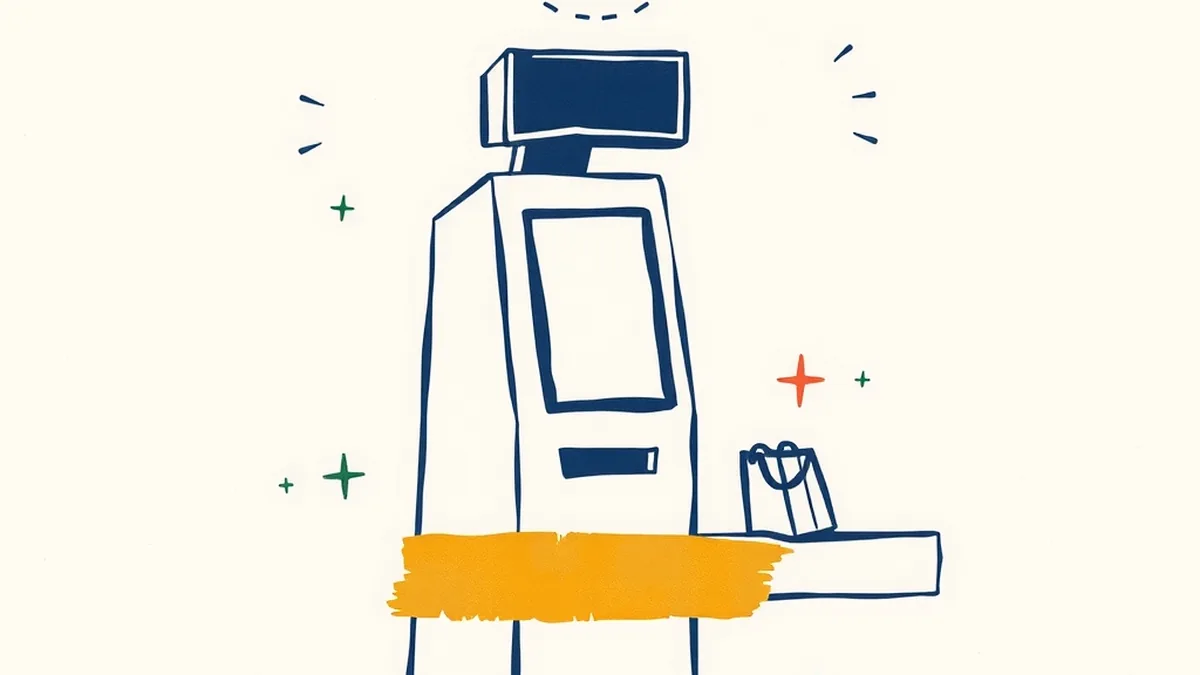
That beeping kiosk has interrupted more school shopping trips than any teenager would like to admit. “Unexpected item in the bagging area” — the phrase has become a cultural punchline, a meme, a moment every student in your grade 7 or 8 class has lived personally. And here is what most AI literacy curricula miss: that machine is one of the most teachable AI systems your students will ever stand next to. It weighs things. It watches them. It second-guesses them. And when it gets confused, it calls a human.
When you frame how self-checkout uses AI as the entry point for a machine-learning lesson, something shifts. The question stops being “what even is AI?” and starts being “wait, why did it yell at me?” That is a much better question for a Tuesday morning — and you do not need a computer lab to answer it.
TL;DR: Self-checkout kiosks use a short pipeline of AI tools: a barcode scanner identifies most items, a weight sensor checks whether the physical item matches expectations, and a computer-vision camera handles produce and catches fraud. Cashierless systems like Amazon Go add ceiling cameras, shelf sensors, and deep learning to track every shopper’s cart in real time. All of this can be taught in 45 minutes with paper, roles, and one surprising plot twist about the human reviewers behind the curtain.
What really happens when you scan an item
The kiosk does three things in under a second, and they run in order.
First, the scanner reads the barcode or QR code. That lookup is not AI — it is a plain database match: barcode number maps to item name and expected weight. The AI lives in what happens next.
Second, a weight sensor compares the object now sitting in the bagging area against the stored expected weight for that item. If a student scans a bag of chips (expected: 140 g) and then sets down a full backpack, the sensor flags a mismatch and triggers the halt. The system is not “smart” here — it is doing math — but the threshold for what counts as a mismatch was trained on millions of weigh-ins. That is machine learning.
Third, an overhead camera runs a computer-vision model — technically a convolutional neural network (CNN) — that identifies items by appearance rather than barcode. This matters for two cases your students will recognize immediately: loose produce (an apple has no barcode, so the camera has to confirm it is actually an apple and not a mango), and barcode-swap fraud (a shopper swaps a cheap item’s sticker onto an expensive one — the weight check and camera together catch the mismatch between the label’s price and the actual object).
This whole first stage is machine perception — the AI system sensing and interpreting the physical world. That is AI4K12 Big Idea #1.
How do cashierless stores like Amazon Go work
Amazon Go went further than a weight sensor and a camera at the register. The stores used what engineers call sensor fusion — combining many signal types into a single picture of what each shopper is doing.
Ceiling-mounted cameras tracked each shopper’s position throughout the store. Shelf weight sensors detected when an item was picked up or returned. A deep-learning model combined those signals to assign each item removal to a specific shopper’s virtual cart — the one tied to the app they checked in with at the door. When they walked out, the cart was charged automatically.
The timeline is worth writing on the board, because the arc is short and surprising:
- July 1986 — CheckRobot deploys the first self-checkout machine at a Kroger near Atlanta.
- December 5, 2016 — Amazon Go opens for internal beta testing.
- January 22, 2018 — Amazon Go opens to the public in Seattle.
- January 2026 — Amazon closes all Go and Amazon Fresh stores in the US; the underlying technology is now licensed to 200+ venues, including stadiums and university campuses.
The deep learning that powered the system learned which object was which from labeled video data — millions of examples of shoppers picking up specific products. More data in, more accurate assignments out. That is AI4K12 Big Idea #3 (Learning — computers learn patterns from data).
For a full unit on how machine learning works across everyday contexts, the How AI Works MEGA bundle — 16 Machine Learning and AI Concept Lessons for Grades 6-12 builds this progression across sixteen lessons, from perception through societal impact.
Was “Just Walk Out” really just AI

This is the section where the lesson gets interesting — and where the literacy work begins.
Amazon marketed Just Walk Out as a smooth, automatic AI system. The reality that emerged in 2024 was more complicated, and teaching students to sit with that complication is the whole point.
Here is what the data shows most clearly: around 2022, approximately 700 out of every 1,000 Just Walk Out transactions required human review before the receipt was finalized. Amazon’s internal target had been roughly 50 per 1,000. That gap — between a system that worked in demos and a system that worked at scale — is itself a lesson in the difference between benchmark performance and real-world deployment.
Then, on April 3, 2024, The Information published a report claiming that more than 1,000 workers, mostly in India, were reviewing shopping video to verify transactions. Amazon removed Just Walk Out from US Amazon Fresh stores the same day. Amazon disputed the framing: VP Jon Jenkins said no one was watching video live, that the team was labeling data “after the fact” to improve the model, and that the number of reviewers was “way less than 1,000.”
Build this as a class discussion around the table below — and teach students that “reported vs. disputed” is itself a media-literacy skill, not a way of saying someone lied.
| What was reported | How Amazon responded |
|---|---|
| More than 1,000 workers, mostly in India, reviewed shopping video (The Information, April 3 2024) | Amazon VP Jon Jenkins said the number was “way less than 1,000” (exact count disputed) |
| Workers watched footage to assign items to carts | Amazon said reviewers labeled video after the fact, not live, to improve the model’s future performance |
| Just Walk Out was presented as fully automatic AI | Amazon said human labeling is a standard part of building and improving machine learning systems |
The literacy move here is not to decide who is right. It is to notice that even companies and credible journalists can disagree on what “AI” means — and that the same set of facts can be framed as “AI that needed human backup” or “AI training pipeline that happened to involve human reviewers.”
This is exactly what ISTE 1.3.b asks students to practice: evaluate the accuracy, credibility, and relevance of information, including information from companies about their own products.
Here is where the belief echo lands. Nobody handed teachers a curriculum for this kind of nuanced, evidence-based AI discussion. That is not a failure of preparation — it is a gap in what has been built. The good news is that a self-checkout kiosk is concrete enough to teach it without a textbook.
Where does store AI get it wrong
The perception and learning layers work well enough most of the time. The equity layer is where things break down — and where the most important classroom conversations happen.
On December 19, 2023, the FTC reached a settlement with Rite Aid, banning the pharmacy chain from using facial recognition for five years. The FTC found that Rite Aid’s system “falsely tagged consumers, particularly women and people of color” as shoplifters. The false alarm rate was higher in stores serving plurality-Black and Asian communities.
Cashierless systems avoid facial recognition — they typically track body shape and gait instead, not face. But body-shape and gait tracking can still produce disparate outcomes for disabled shoppers (who move differently), shoppers wearing heavy coats, and people of color in certain lighting conditions. Rutgers marketing professor Jerome Williams has documented these patterns in cashierless retail contexts.
The standards frame: AI4K12 Big Idea #5 (Societal Impact — what happens when a biased system is deployed at scale), ISTE 1.2.d (managing digital identity and personal data privacy — shoppers are being tracked whether they opt in or not).
For a ready-to-run lesson on surveillance AI and its equity implications, the AI Surveillance and Privacy Lesson for Grades 6-8 covers this territory with structured discussion, primary sources, and student reflection. The facial recognition deep-dive lives in the companion post: Facial Recognition Lesson Plan for Middle School.
A no-device lesson: Be the Store Camera (45 minutes)

What it is
Students role-play the sensors inside a cashierless store — no phones, no laptops, no login required. The activity surfaces how sensor fusion works, why human review is sometimes necessary, and what the system cannot see.
Roles
Assign each student one of four roles:
- Camera crew (3-4 students) — stand at the perimeter, observe which “shopper” touches which object, call out item picks by object color
- Weight sensors (2 students) — sit behind a table, record a number written on a sticky note under each object (the “expected weight”), and flag when the shopper’s reported pick does not match
- AI model (1 student) — receives signals from cameras and weight sensors and announces the cart total
- Shopper (1-2 students) — moves through the space, picks up objects, occasionally makes an ambiguous or contested move
Pacing
| Minutes | What happens |
|---|---|
| 0-5 | Hook: show the “unexpected item” video clip or describe the kiosk moment. Ask: “What is the machine actually checking?“ |
| 5-15 | Assign roles, explain the signal protocol (cameras shout color, weight sensors hold up a number, model synthesizes) |
| 15-30 | Run two clean rounds — shopper makes standard picks, model builds the cart correctly |
| 30-40 | Twist round: cameras disagree (one says “green bottle,” one says “blue bag”), weight sensor flags a mismatch, model cannot decide — a designated “human reviewer” must step in and watch a recorded replay |
| 40-45 | Debrief: what made the twist round hard? What would a real system need to resolve it? When should a human always be in the loop? |
A typical class finishes rounds one and two in about 30 minutes. Faster groups can run a second twist scenario where the shopper returns an item mid-trip — which requires the AI model to subtract from the cart, a move that trips real cashierless systems.
The twist round is the pedagogical load-bearing moment. It mirrors exactly what the 700-per-1,000 human-review rate represents in practice: a real system where the signals disagree and a person has to decide.
Standards coverage: ISTE 1.3.d (build knowledge by actively exploring real-world issues through investigation), CCSS.ELA-LITERACY.SL.7.1 (engage effectively in collaborative discussions with diverse partners).
For a full set of no-device AI activities built on this approach, the Unplugged AI Activities bundle — 10 No-Tech Lessons, Card Sort, Role Play, Grades 6-8 has ten activities in the same format: roles, rounds, a twist, and a debrief.
How this maps to *standards
| Activity step | Standard code | What students do |
|---|---|---|
| Kiosk pipeline explainer (barcode → weight → camera) | AI4K12 Big Idea #1 (Perception) | Identify how AI systems interpret physical-world input |
| Amazon Go timeline + deep learning explainer | AI4K12 Big Idea #3 (Learning) | Describe how systems improve from labeled data |
| Just Walk Out reported vs. disputed table | ISTE 1.3.b | Evaluate credibility and perspective of competing sources |
| Just Walk Out reported vs. disputed table | CCSS.ELA-LITERACY.W.7.8 | Gather information from multiple sources; assess accuracy |
| Rite Aid FTC settlement + equity discussion | AI4K12 Big Idea #5 (Societal Impact) | Analyze real-world consequences of biased AI deployment |
| Rite Aid / gait tracking / surveillance systems | ISTE 1.2.d | Examine how personal data is collected without explicit consent |
| Be the Store Camera — all rounds | ISTE 1.3.d | Build knowledge through active investigation of a real-world problem |
| Be the Store Camera — debrief | CCSS.ELA-LITERACY.SL.7.1 | Engage in structured collaborative discussion |
Standards source: ISTE Student Standards. ISTE is a registered trademark of the International Society for Technology in Education. These resources are not affiliated with or endorsed by ISTE.
For more in this series — the same concreteness applied to a different everyday AI system — the How Voice Assistants Work lesson for middle school runs the same perception-to-societal-impact arc with a device every student has talked to.
This post was drafted with AI assistance and human-finalized.
Quick questions
Self-checkout kiosks combine three tools: a barcode scanner identifies most items, a weight sensor checks the item against its expected weight, and a computer-vision camera recognizes produce and catches barcode-swap fraud. The camera's object recognition is the machine-learning part.
Both. Amazon Go used cameras, shelf weight sensors, and deep learning to track carts automatically, but around 2022 roughly 700 of every 1,000 transactions still needed human review. Reports in 2024 said over 1,000 workers reviewed footage; Amazon disputed the exact number but confirmed humans labeled video to improve the system.
It can be. In 2023 the FTC banned Rite Aid from facial recognition after finding it falsely tagged women and people of color as shoplifters, with more false alarms in plurality-Black and Asian communities. Cashierless systems avoid faces but track body shape and gait, which can still produce unequal outcomes.
Get the free AI-Proof Assignment Toolkit
10 ways to redesign any assignment so an AI chatbot structurally can't do it — plus a redesign worksheet, a 45-minute lesson, the “Spot AI Work” card, and parent templates. One email, all 5 pieces.
Prefer the full breakdown? See everything inside the toolkit →