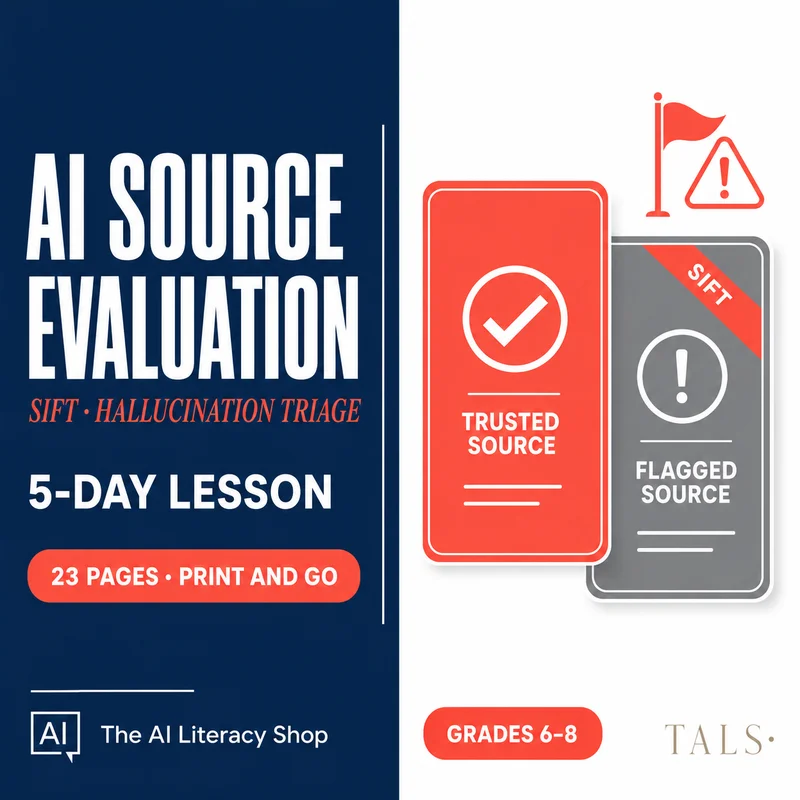
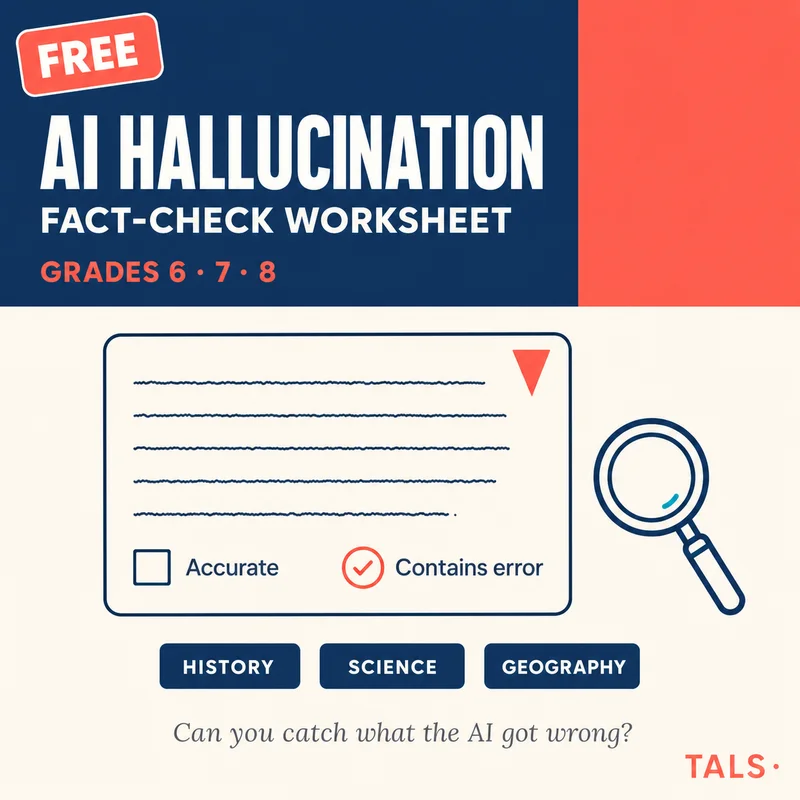
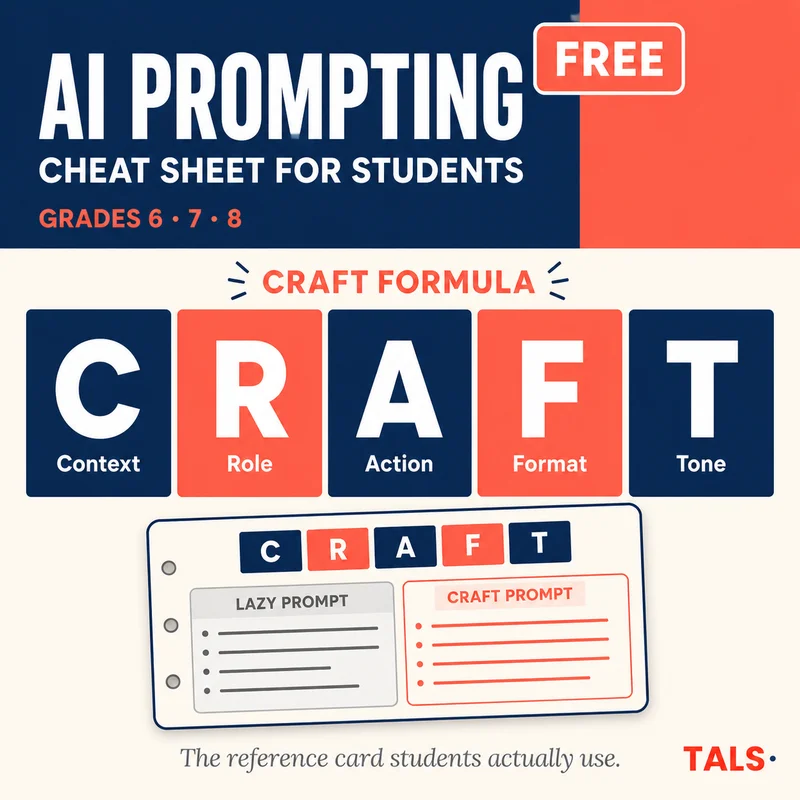
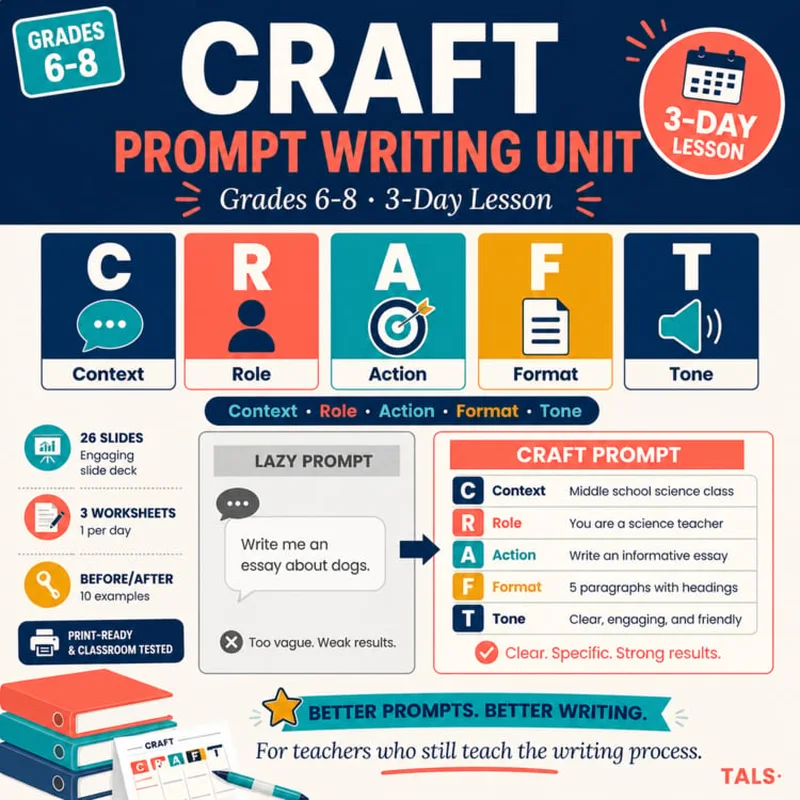
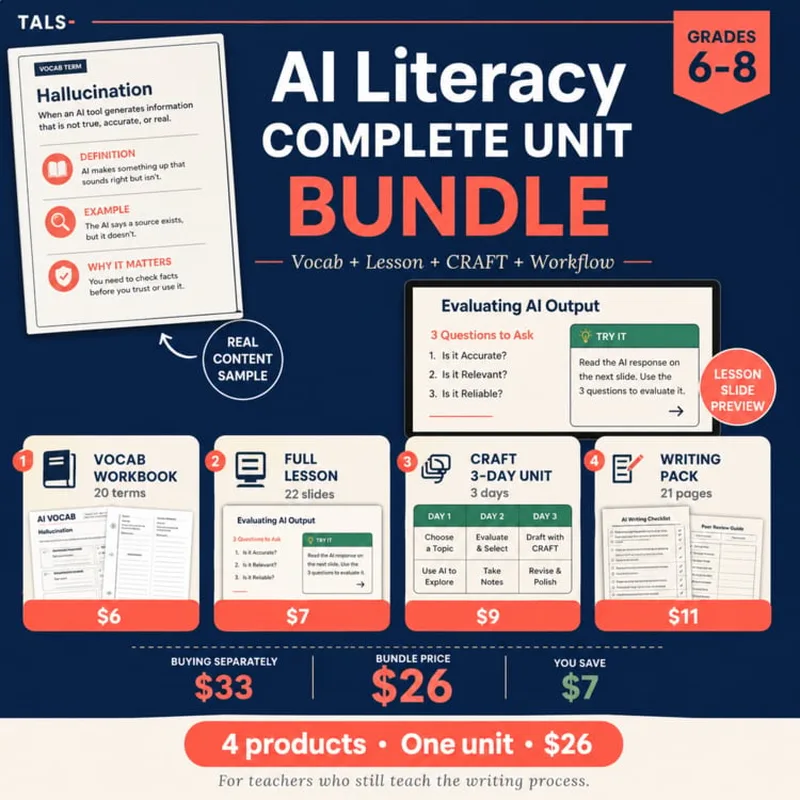
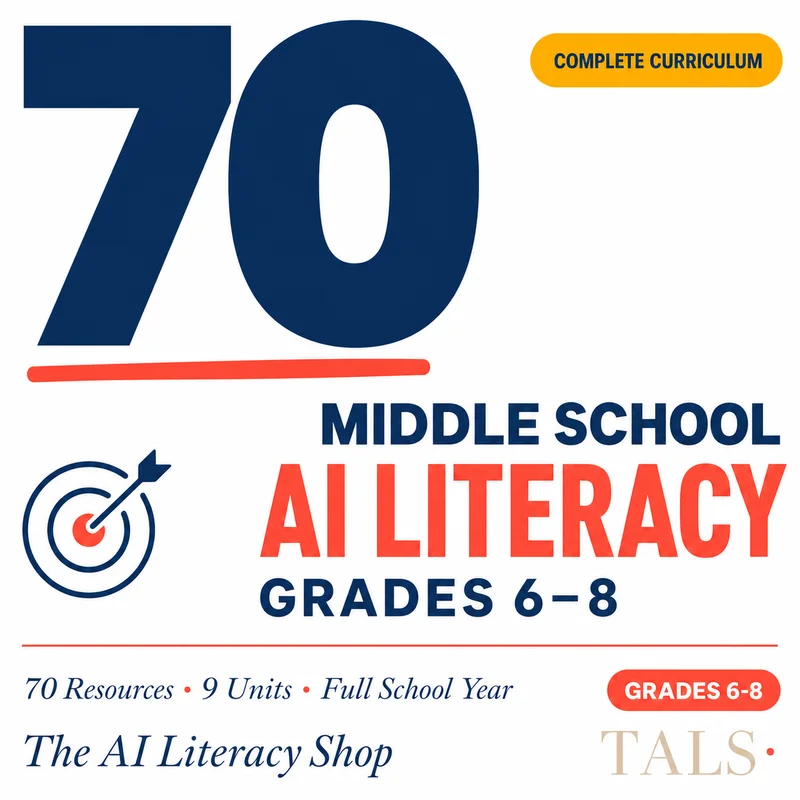
Complete Middle School AI Literacy Curriculum
The entire 6–8 year in one download — vocabulary, prompting, bias, ethics and media literacy, sequenced and answer-keyed.
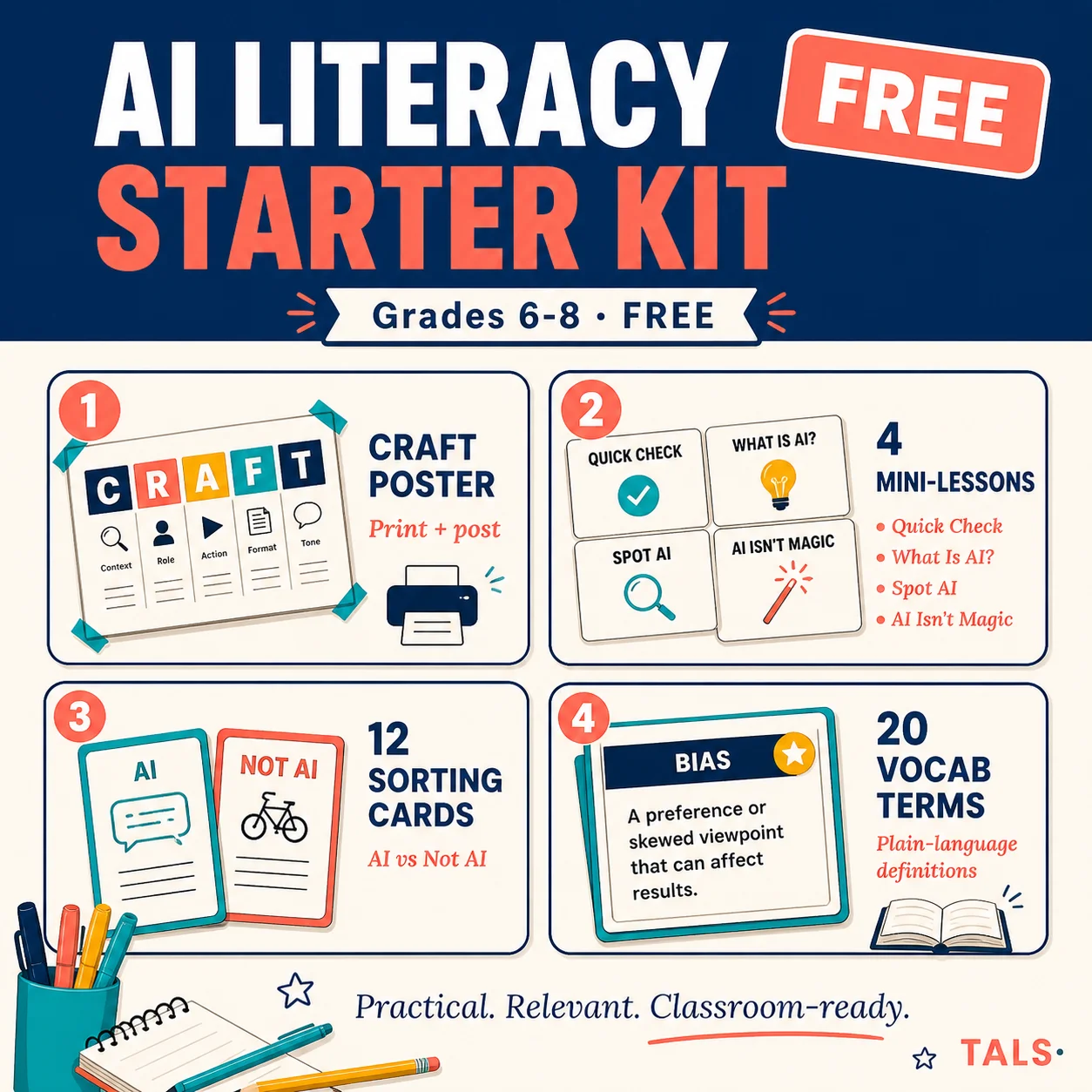
See what's inside on TPTYou were told to teach AI literacy. Nobody handed you a curriculum. So we built it — print-ready lessons for grades 6–12, sequenced into a real program and mapped, on the page, to specific ISTE and CCSS codes.
No paid AI account required · everything prints on paper
 the whole year
 Most "AI curriculum" is a folder of loose lessons you still have to order, pace, and defend. Ours is the whole arc — planned by grade, cross-cut by strand, and answer-keyed. Two complete years, ready to teach.
The entire 6–8 year in one download — vocabulary, prompting, bias, ethics and media literacy, sequenced and answer-keyed.
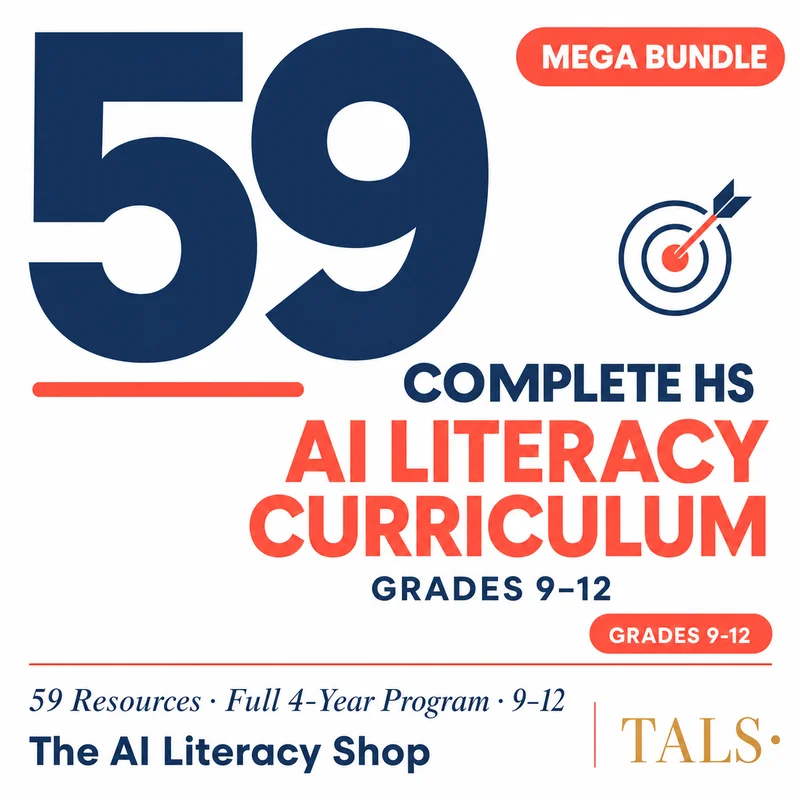
See what's inside on TPTEvery resource on the four-year map, built: foundation to AP-rigor to capstone — print-and-go lessons, workbooks and AP-style assessments.
See what's inside on TPTWhat AI is and how it's trained — the vocabulary and habits every later unit builds on.
Prompting, bias and fact-checking put to work in ELA, science and social studies.
Evidence, citation and argument at the level AP and honors classrooms expect.
Students use AI with judgment on a real project — and can defend how they did it.
The high-school arc, shown. Middle school runs the same spine, paced for grades 6–8.
Every lesson lists the exact ISTE, CCSS and AI4K12 codes it meets — verbatim, with sources. Pick a subject and tap a code.
Standards stamped on this lesson — tap a code to read the exact wording:
Here's the anatomy of one lesson — "What Is AI?" The cover is the real product; the pages show the structure every lesson in the program follows. Flip through it.
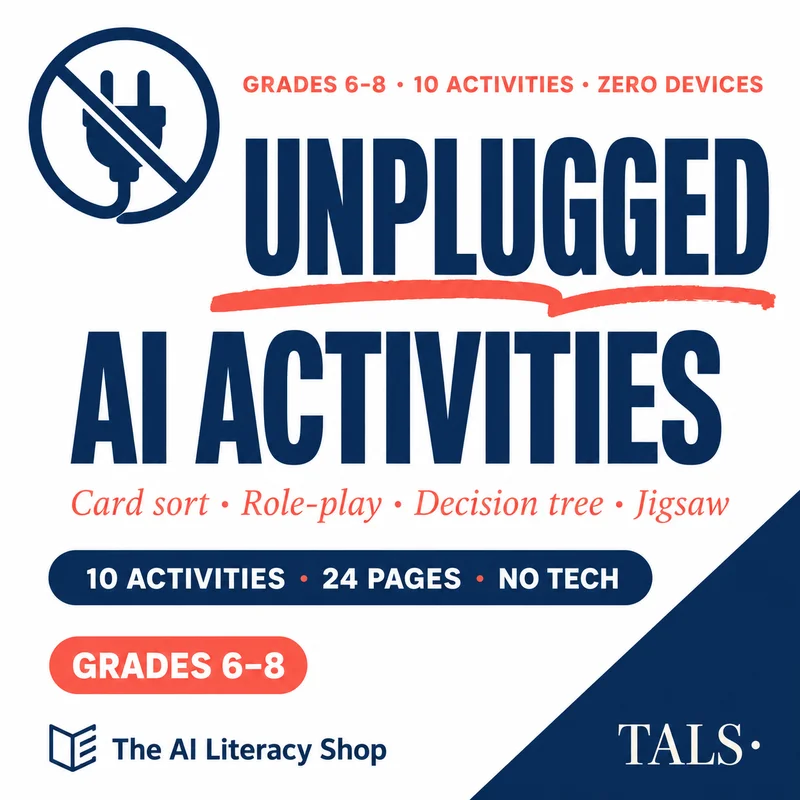
A 45-minute first-day introduction: plain-language vocabulary, a sorting activity, and a short reflection. No devices needed.
Is it AI? Read each example. Decide if it uses artificial intelligence, then explain how you can tell.
How did you decide?
| Code | What the standard says |
|---|---|
| ISTE 1.3.dKnowledge Constructor | "Build knowledge by actively exploring real-world issues and problems, developing ideas and theories and pursuing answers and solutions." |
| CCSS.W.7.8Common Core · Writing | "Gather relevant information from multiple print and digital sources… assess the credibility and accuracy of each source…" |
| AI4K12 · BI 5Societal Impact | From the AI4K12 "Five Big Ideas in AI" framework — how AI affects people and society. |
Sources: iste.org · thecorestandards.org · ai4k12.org. ISTE is a registered trademark of the International Society for Technology in Education; these resources are not affiliated with or endorsed by ISTE.
Teacher note: the goal isn't a perfect score — it's the reasoning. Accept any answer where a student names whether the system learns from data.
↑ yes — even the answer key is in there
Not a single classroom teacher, and not a district. We build, test and document AI-literacy lessons full-time, then map every one to specific ISTE, CCSS and AI4K12 codes. We say that plainly because you deserve to know exactly who made the worksheet your students will hold.
A full unit that teaches students to write clear, honest prompts — and to read AI output critically.
Open on TPTA starter sequence in one download — vocabulary, prompting, bias and fact-checking. A smaller step toward the full year.
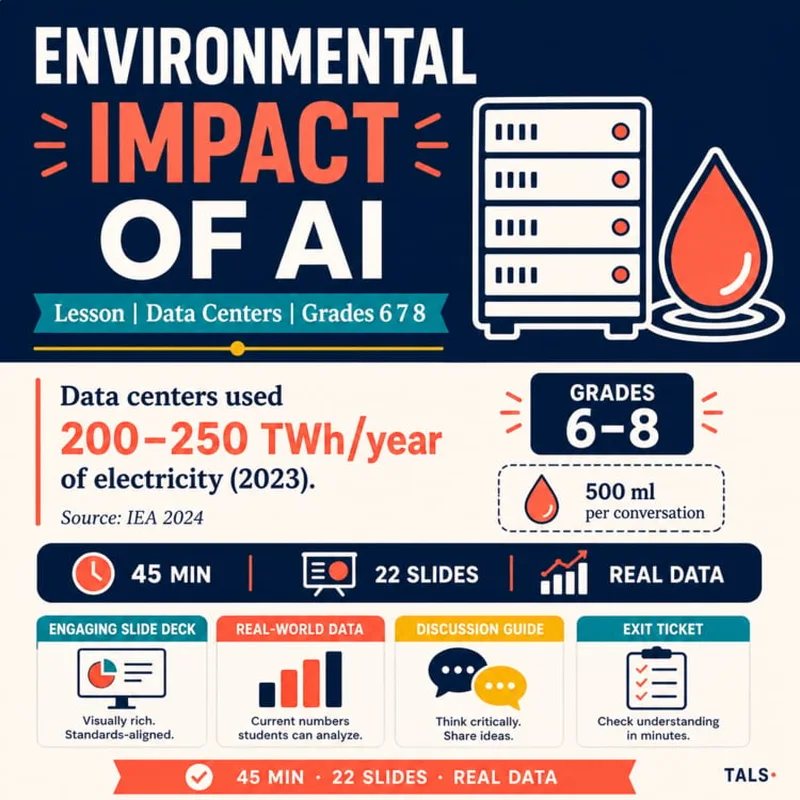
Open on TPTA data-driven lesson on what AI actually costs the planet — reading, discussion and an evidence-based writing task.
Open on TPTNo sales pitch. You've been burned by "AI curriculum" before — here's what we'd want to know in your shoes.
A real, sequenced program. The middle-school and high-school curricula each run a full year — planned by grade, cross-cut by strand, and answer-keyed — so you can adopt the whole thing or teach it unit by unit. Individual lessons are the rungs; the curriculum is the ladder.
No. Every lesson is built to run on paper — students don't need an AI account and neither do you. If your room has devices, the lessons work just as well; they don't require it.
Every lesson ships with a standards-alignment page that prints the exact ISTE, CCSS and AI4K12 codes — verbatim — with their sources. You saw one above. Check them against the official frameworks yourself; that's the point.
Both bands: a complete middle-school (6–8) curriculum and a complete high-school (9–12) curriculum are live, plus hundreds of standalone lessons. We tell you a lesson's grade band up front rather than stretch a claim to cover a grade it wasn't written for.
You buy and download on Teachers Pay Teachers, using the account you already have. We keep the shop here so the catalog is easy to browse, but TPT handles checkout, receipts and your school's purchase orders. Buy once, print fresh copies every year — no subscription, no expiry.
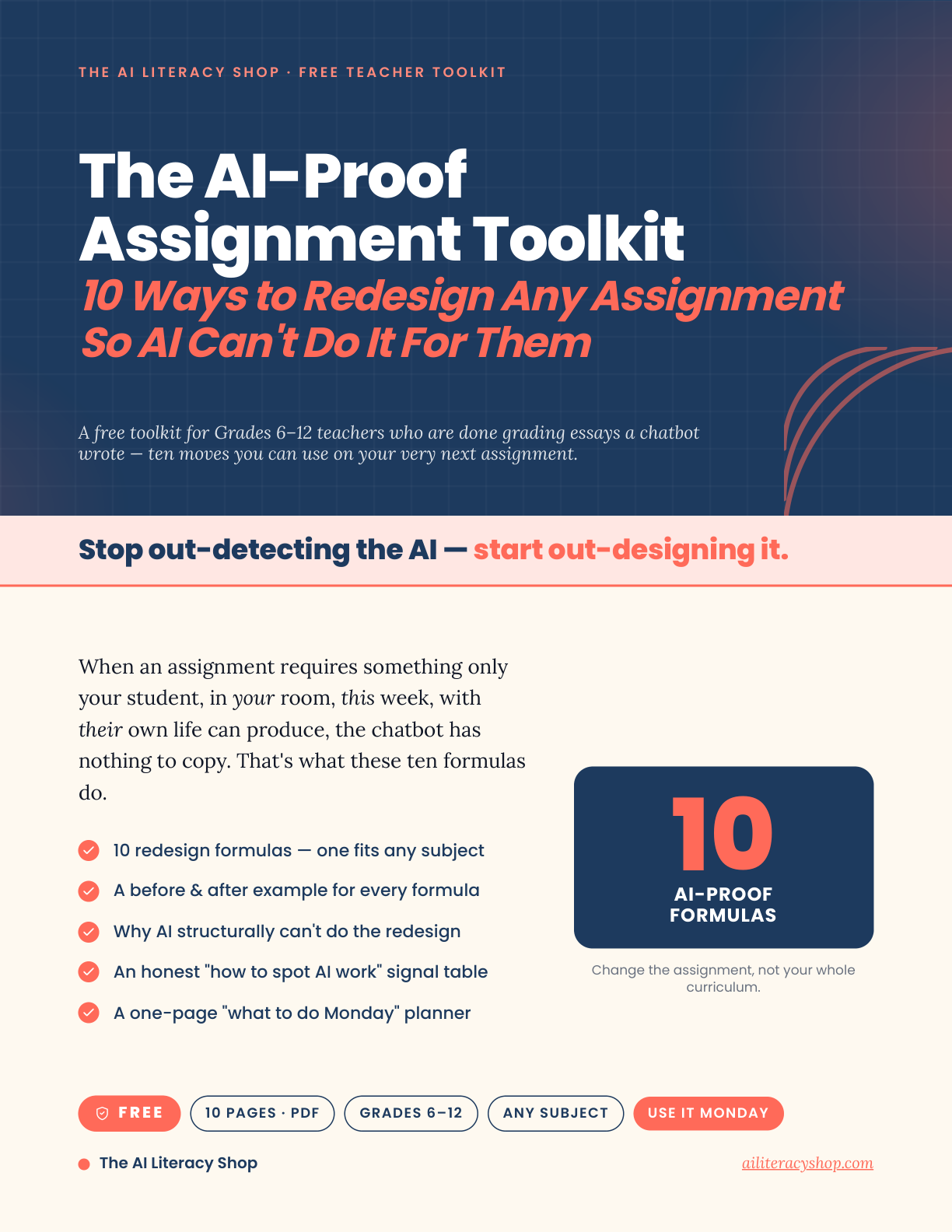
Worried about AI doing the homework? 10 ways to redesign any assignment so a chatbot structurally can't do it — 5 ready-to-print pieces, sent by email.
Get the free toolkit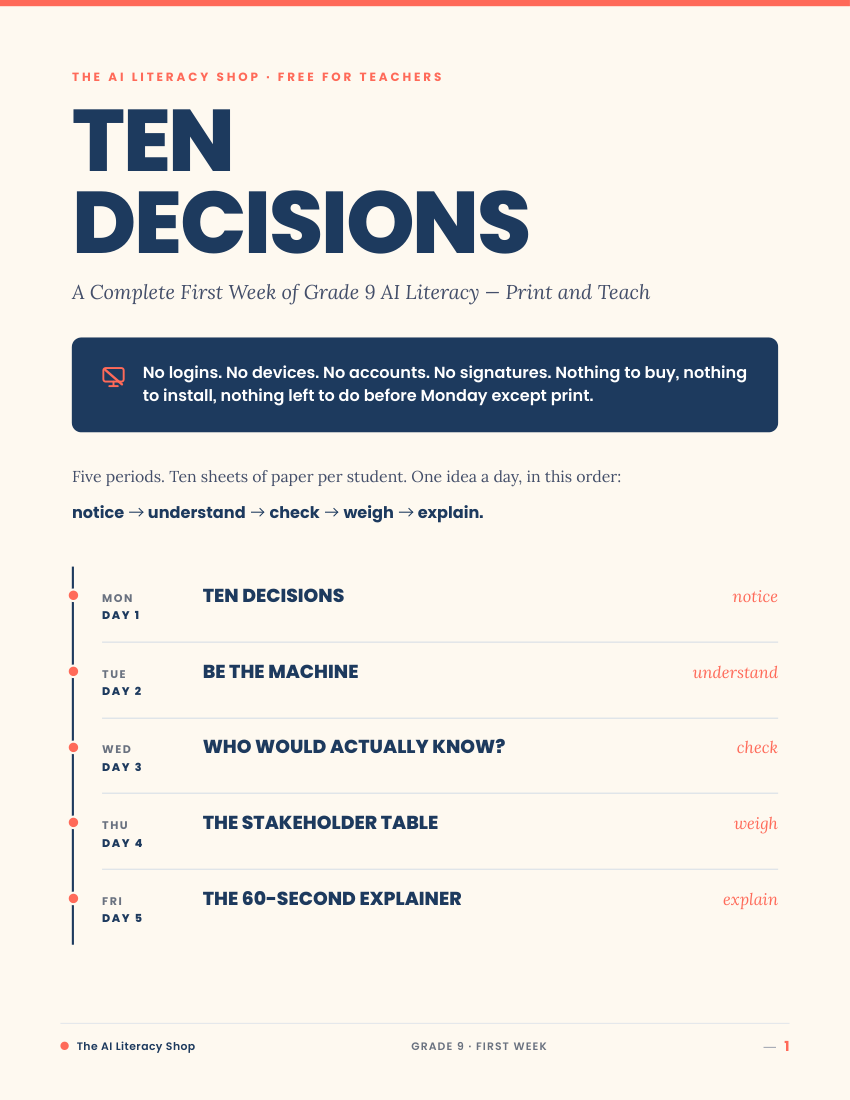
Told to teach AI literacy with nothing to teach it with? Five days for Grade 9, already written — teacher scripts, student handouts, answer guidance. Print it Friday, teach it Monday.
Get the free weekBoth are free, printable, and yours to keep — see everything free here.
 Grade 6-8
 How AI recognizes songs, explained for middle school: the Shazam audio-fingerprint pipeline, why humming fails, and a no-device classroom lesson.
 Grade 6-8
 How AI photo search works, explained for middle school: the tag, embed, and match pipeline, where it goes confidently wrong, and a no-device classroom lesson.
 Grade 6-8
 Learn how phone cameras use AI to synthesize photos — the 7-stage pipeline, the Samsung moon controversy, and a 45-minute no-device lesson for grades 6-8.
A peek at the catalog